
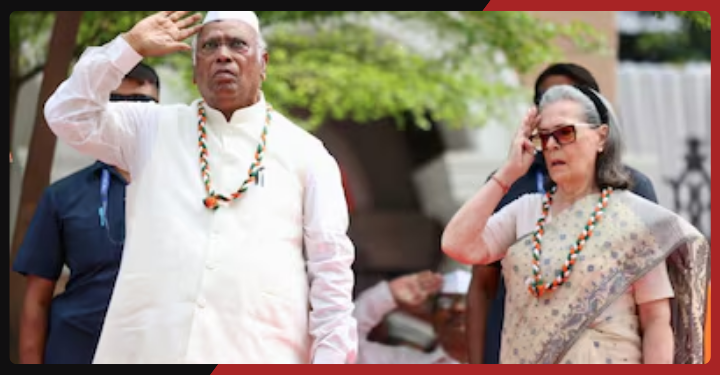
A viral video has triggered a political storm between the BJP and Congress after Sonia Gandhi was seen making gestures during the rendition of “Vande Mataram” at the Congress headquarters on Independence Day. BJP leaders claimed the gesture showed an attempt to stop the song, while Congress said the interpretation was incorrect and that Gandhi was asking for a chair for party president Mallikarjun Kharge.
The controversy has emerged during a particularly important year for “Vande Mataram.” In 2026, the national song is marking its 150th anniversary. The government has highlighted its historical importance and included it prominently in the Independence Day celebrations at the Red Fort. The song was performed there before the national anthem, marking a historic first for the ceremony.
At the Congress headquarters in Delhi, senior party leaders gathered for the Independence Day celebration. The event included the rendition of “Vande Mataram.” During the performance, Sonia Gandhi and Kharge were seen making gestures, while Rahul Gandhi was later seen making a similar movement.
The footage soon became the focus of political criticism.
BJP leaders alleged that the gestures were directed towards people involved in the rendition and suggested that the Congress leadership wanted the song to be stopped. The allegations quickly spread online, with opponents accusing the party of disrespecting a national symbol.
Congress rejected the allegation. According to the party, the complete version of “Vande Mataram” was sung at the event. Jairam Ramesh said there was no controversy and defended the conduct of the party leaders.
The party also provided a specific explanation for Sonia Gandhi’s gesture. It said she was seeking a chair for Kharge, rather than asking anyone to stop the song. This explanation was reported in coverage of the dispute.
The controversy demonstrates why context is essential when analysing viral videos. The visual clip can show a person raising a hand or pointing in a particular direction, but it may not reveal what was said before or after the gesture.
For BJP leaders, the timing is important. They argue that the gesture occurred while “Vande Mataram” was being performed and therefore appeared connected to the rendition.
Congress takes the opposite view. It argues that the gesture had a practical purpose and that the completion of the song proves there was no attempt to stop it.
The national significance of “Vande Mataram” adds another layer to the dispute. The song became an important part of the freedom movement and was associated with the anti-colonial struggle. Its historical importance was recognised after Independence, when it was given national-song status and equal honour with the national anthem.
The song’s history is also politically complex. Its later verses have historically been the subject of debate because of religious imagery, which led to discussions during the freedom movement about which portions should be used at national gatherings. The first two stanzas eventually became the commonly accepted national rendition.
In 2026, the government has sought to place the complete song in greater focus as part of its 150th-anniversary celebrations. This has made the issue of the full rendition particularly sensitive.
The Sonia Gandhi controversy therefore arrives at a moment when “Vande Mataram” is already part of a broader national debate.
The BJP’s political argument is that respect for national symbols should not be compromised, especially during Independence Day. Congress’s political argument is that its leaders are being unfairly targeted on the basis of a misleading interpretation of a gesture.
For the public, it is important to understand that there are two separate questions. The first is what the video shows. The second is what the gesture meant. The first can be observed; the second requires context.
The footage shows Sonia Gandhi making gestures. News reports also confirm that BJP leaders interpreted them as an attempt to stop the rendition. Congress has denied that interpretation and offered an alternative explanation.
That means the claim that Sonia Gandhi deliberately “insulted” the national song remains disputed.
The controversy is likely to continue because it fits into a larger political conflict over nationalism, national symbols and the ideological differences between BJP and Congress.
Social media will also play an important role. Supporters of each party are likely to circulate the same footage with very different captions. Some will use it to criticise Sonia Gandhi, while others will share the Congress explanation and accuse the BJP of political opportunism.
The incident ultimately illustrates how political narratives can emerge from moments lasting only a few seconds. In an era when every major public event is recorded, leaders must expect even ordinary gestures to be examined and interpreted.
Whether the controversy eventually leads to a broader political confrontation remains to be seen. For now, Congress is firmly defending Sonia Gandhi, while the BJP continues to question the conduct seen in the viral video.



More Stories
‘Regime Change’ Debate: How RSS Chief’s Remarks Intensify India’s Political Row
Voter-List Controversy Fuels CJP’s Protest as Dipke Challenges Election Commission
Tragedy in Hyderabad as Young Software Engineer Dies in High-Rise Fall