
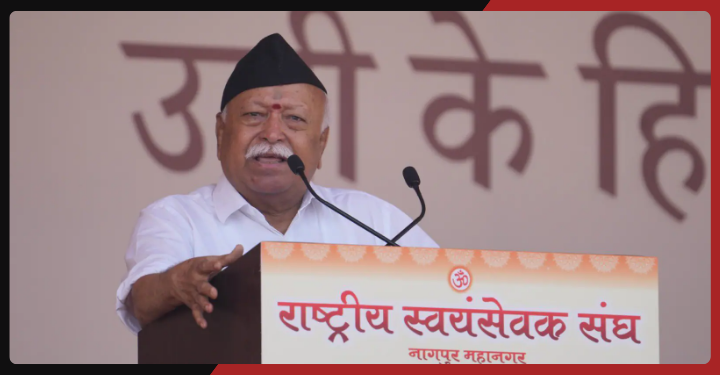
The phrase “regime change” has become a focus of political debate in India following remarks by RSS chief Mohan Bhagwat at the organisation’s annual Vijayadashami celebrations in Nagpur on October 20, 2026. Bhagwat cited unrest in France, Albania, Bangladesh and Nepal while arguing that changing governments does not automatically solve a country’s underlying problems. He also warned that attempts to destabilise India would not succeed.
NDTV
+1
The controversy comes amid protests linked to the Election Commission and demands for greater accountability in electoral processes. Political leaders have offered sharply different interpretations of these demonstrations, turning the question of political change into a wider dispute about democratic rights, institutional credibility and national stability.
Bhagwat’s remarks reflect concern that public movements can be used by people pursuing their own political interests. He argued that demonstrations should aim to resolve problems rather than create hostility between sections of society. He also suggested that international developments show the risks associated with efforts to replace political leadership without addressing deeper grievances.
The opposition’s position, however, has included the argument that demanding accountability from public institutions is a legitimate democratic activity. Congress MP Shashi Tharoor, for example, rejected comparisons between India and countries experiencing political unrest, arguing that opposition efforts concerning electoral issues should not automatically be characterised as an attempt to overthrow the government.
This disagreement highlights the different meanings attached to the phrase “regime change”. In international politics, it can refer to efforts to remove or replace a government, sometimes through coercive or externally supported means. In domestic political debate, the phrase may also be used more broadly to describe an objective of replacing the ruling party through political competition.
These meanings should not be treated as interchangeable. In a democratic system, opposition parties routinely seek to defeat the government in elections. Such efforts are part of the political process, provided they follow constitutional rules and applicable law.
Similarly, protests over institutional conduct do not necessarily indicate an attempt to seize power. Demonstrations can focus on specific demands, such as explanations for administrative decisions, changes in procedures or investigations into alleged irregularities.
At the same time, public movements can generate serious tensions if political rhetoric encourages hostility or if demonstrations become violent. Authorities have a responsibility to enforce the law fairly, while organisers and political leaders should ensure that their actions remain peaceful.
The controversy also raises a question about institutional trust. When citizens believe that a public institution is not responding adequately to concerns, political disputes can become more intense. Transparent procedures, accessible complaint mechanisms and credible investigations can help reduce uncertainty.
Bhagwat’s speech emphasised the importance of stability and social unity. His critics may argue that such concerns should not be used to dismiss legitimate questions about electoral administration. Both perspectives point towards the need for clear evidence and effective democratic safeguards.
Ultimately, the debate cannot be resolved simply by applying a label to a protest or political campaign. The objectives of the organisers, the methods used, the evidence supporting their claims and the constitutional framework all matter.
India’s democratic strength depends on its ability to manage political competition without undermining institutions or restricting legitimate dissent. Bhagwat’s remarks have sharpened the debate, but the lasting question is whether the political establishment can address public grievances while maintaining peaceful and constitutional processes.


More Stories
Voter-List Controversy Fuels CJP’s Protest as Dipke Challenges Election Commission
Tragedy in Hyderabad as Young Software Engineer Dies in High-Rise Fall
Opposition’s Protest Over Election Commission Puts Democratic Rights in Focus