
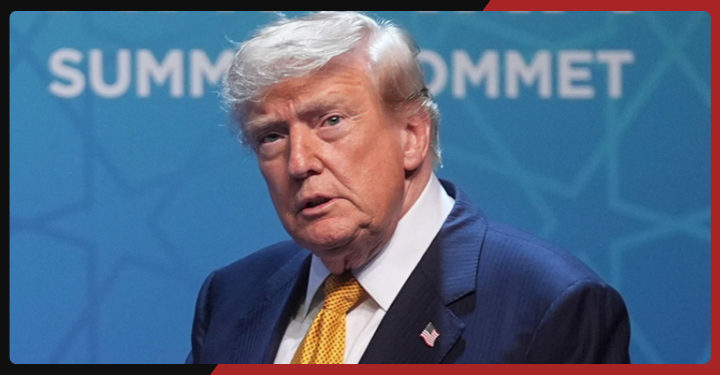
The extraordinary decision to secretly move Donald Trump onto a different aircraft during his departure from Turkey has raised a fundamental question: how serious was the threat that triggered the operation?
New reporting suggests the answer was not straightforward.
American officials received intelligence from Israel warning about a possible Iranian plot against Trump. Yet CIA analysts reportedly assessed the information with low confidence. Some officials reportedly questioned whether the warning was independently verifiable or whether it reflected broader Israeli concerns about Iran.
Despite those doubts, Trump’s security team decided to take extraordinary precautions.
The operation occurred on July 8 after Trump attended a NATO summit in Ankara.
Trump had traveled to Turkey aboard a new Boeing 747-8 donated by Qatar and modified for presidential service. But the president did not simply board that aircraft for his return journey.
Instead, he was publicly seen entering the older Air Force One.
That was reportedly part of a carefully planned deception.
Trump was then moved secretly to a catering vehicle and taken to a C-32A military aircraft. He and a small number of aides flew separately, while the aircraft visible to journalists continued to operate as a decoy.
The unusual maneuver reportedly reflected two connected concerns.
The first involved intelligence about Iran.
The second involved the capabilities of the new presidential aircraft.
The United States has long regarded Iranian threats against senior American officials as a serious security issue. Trump has been a particular target of Iranian hostility since the 2020 US strike that killed Qasem Soleimani.
The threat environment became even more complicated during the conflict involving Iran and Israel.
Against this backdrop, Israel reportedly informed US officials that Iran was developing a new plan to target Trump.
But American intelligence analysts did not apparently accept the information at face value.
The CIA reportedly regarded the warning as low confidence.
This does not mean analysts dismissed it completely.
Instead, it meant that the available evidence was not considered strong enough to prove that an attack was imminent.
That distinction matters because intelligence assessments often contain uncertainty.
A low-confidence assessment can still prompt action if the potential consequences are severe.
For the Secret Service, the calculation was relatively simple.
If the intelligence was wrong, moving Trump to another aircraft would be an inconvenience.
If the intelligence was correct, failing to act could have catastrophic consequences.
The agency therefore appears to have chosen the safer option.
The aircraft issue made that decision easier.
The new Qatari aircraft had been modified for presidential use, but it was not originally built specifically as Air Force One. Experts have pointed out that the traditional presidential aircraft include specialized defensive systems and were designed around the unique demands of protecting the president.
Reports said the threat warning included concern about a possible missile attack.
One account said US officials had been told that someone near the NATO summit may have been seen carrying a shoulder-fired surface-to-air missile.
Such a threat would be particularly concerning during departure from an airport because aircraft are more vulnerable while climbing or descending.
Still, the available public information does not establish that an Iranian operative actually attempted to attack Trump.
The intelligence remains disputed.
That is why the CIA’s reported skepticism has become such a significant part of the story.
It also raises questions about the role of foreign intelligence in American national-security decisions.
Israel and the United States have a close intelligence relationship, particularly concerning Iran. Israeli agencies have extensive sources and capabilities focused on Tehran.
However, allies do not always agree on the interpretation of intelligence.
American analysts are expected to challenge information when they believe it is insufficiently supported.
The reports suggest that this happened here.
At the same time, the Secret Service was under no obligation to wait for complete certainty.
Its responsibility was to protect the president.
Trump later said the aircraft switch was directed by the Secret Service and that he followed its instructions.
The secrecy of the operation was itself significant.
Had Trump simply changed aircraft publicly, anyone monitoring his movements would have known where he was going.
By maintaining the appearance that he was traveling on another plane, security officials reduced the amount of information available to potential attackers.
The operation reportedly ended with Trump reaching Britain before eventually continuing his journey.
The episode has since become a major test for the new presidential aircraft.
The plane was intended to offer the president additional transportation capacity, but its use in a potentially hostile environment has now been questioned.
Officials may have concluded that the established Air Force One fleet offered a higher level of confidence during a specific threat scenario.
That does not necessarily mean the new aircraft is unsuitable for presidential travel.
Rather, it shows that presidential aviation is governed by different threat levels and security requirements.
The larger lesson is about uncertainty.
Governments rarely receive intelligence that comes with absolute certainty. They must make decisions based on probabilities.
In Trump’s case, American analysts reportedly had doubts about the Israeli warning.
The Secret Service nevertheless decided that the risk was too important to ignore.
The result was a highly unusual operation that combined intelligence, deception and presidential aviation security.
Whether the original warning ultimately proves accurate may never be publicly known.
But the Turkey incident demonstrates how even uncertain intelligence can lead to extraordinary action when the person at risk is the president of the United States.


More Stories
Historic Tennessee Execution Turns Into Medical Emergency After Drug Failure
Israel-Bound Flydubai Flight Triggers Security Alert After Violent Cockpit Incident
Essar’s US Steel Ambition: Iowa Plant Expected to Produce 10 Million Tons by 2030