
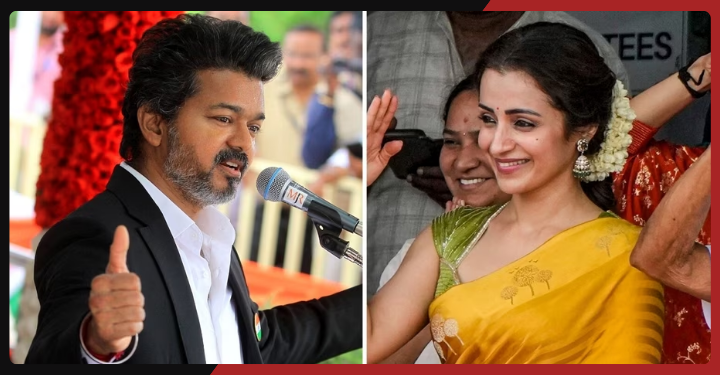
The controversy surrounding alleged double-meaning remarks involving actor Trisha Krishnan has become the latest major flashpoint in Tamil Nadu’s increasingly intense political battle between Chief Minister C. Joseph Vijay’s Tamilaga Vettri Kazhagam and the opposition DMK.
What began as a controversy over a viral incident at a public protest has now reached the Tamil Nadu Assembly, where Vijay strongly condemned abusive, defamatory and degrading language against women.
The episode has become politically important because it involves several powerful elements of Tamil Nadu public life: cinema, celebrity, political rivalry, social media and questions about women’s dignity.
The controversy began during a Cauvery-related protest in Thanjavur last month.
Opposition leader Udhayanidhi Stalin was speaking when people in the crowd reportedly began chanting the name of actor Trisha.
A subsequent comment made by him was interpreted by critics as an inappropriate innuendo directed at the actor.
The video spread rapidly online and triggered criticism from Vijay’s party.
TVK representatives condemned the alleged comment and accused the opposition of lowering the standard of political discourse.
The controversy intensified because Trisha has been associated professionally with Vijay through cinema, while speculation about their friendship has frequently generated discussion among fans and on social media.
This made the political controversy even more sensational.
However, Udhayanidhi Stalin rejected the accusations against him.
He said his words were being misinterpreted and maintained that his comments were related to the Cauvery water issue rather than an attempt to insult Trisha.
The dispute soon developed into a political confrontation between the ruling and opposition camps.
Vijay eventually addressed the broader issue in the Assembly.
Without naming Udhayanidhi Stalin, he criticised the use of double meanings and defamatory language against women.
He said political criticism was legitimate, but personal attacks and humiliation were unacceptable.
The Chief Minister also warned that the law would take appropriate action if women were insulted.
His comments represented a significant escalation in the political response to the controversy.
Rather than treating the incident as a temporary social media dispute, Vijay placed it within the larger framework of political behaviour and public accountability.
He argued that freedom of speech should be exercised responsibly.
Political leaders, he suggested, could criticise opponents as strongly as they wanted on political matters.
But they should not use politics as an excuse to demean individuals.
Vijay’s remarks also reflected the changing political environment in Tamil Nadu.
The emergence of TVK as a major governing force has created new lines of confrontation.
The state’s traditional political equations have been disrupted, and the rivalry between Vijay’s government and the DMK has become increasingly visible.
The Trisha controversy has therefore become another symbol of this larger political struggle.
Both sides have accused the other of acting with political motives.
For TVK, the controversy has become an opportunity to raise questions about respect for women and the quality of opposition politics.
For Udhayanidhi Stalin and the DMK, the dispute has also involved allegations that his original remarks were misrepresented or politically weaponised.
The result is a controversy with multiple layers.
At its centre is the question of what was said and what was intended.
But surrounding that question are larger issues of political rivalry, celebrity culture and public accountability.
Vijay’s Assembly speech has now ensured that the issue will remain politically relevant.
His warning against double-meaning language has also broadened the debate beyond one individual.
The Chief Minister has effectively challenged all political leaders to consider the language they use in public.
As the TVK-DMK rivalry continues, the Trisha controversy may remain a reminder that modern Tamil Nadu politics is increasingly shaped not only by policies and elections but also by viral videos, public perception and the power of words.


More Stories
Dipke’s Warning Signals Wider Clash Over Election Commission’s Role
Flydubai Crisis: Injured Indian Captain Smit Machchhar Helps Passengers Regain Control
Historic Tennessee Execution Turns Into Medical Emergency After Drug Failure