
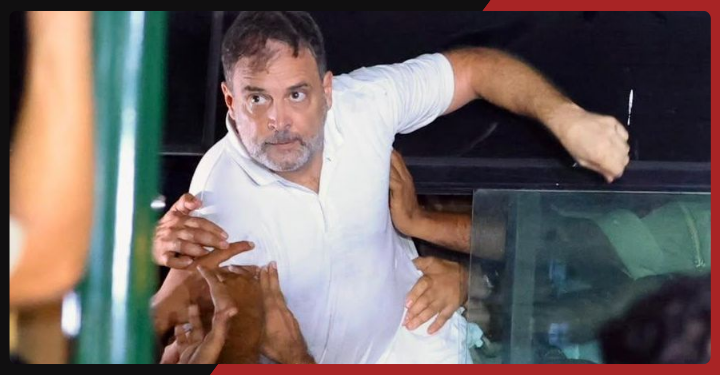
The political confrontation between the opposition and India’s election authorities intensified in New Delhi after Rahul Gandhi was detained by Delhi Police during a protest demanding the resignation of Chief Election Commissioner Gyanesh Kumar. The demonstration brought together opposition lawmakers who were seeking answers over electoral-roll revisions and what they described as concerns about the integrity of the voting process.
The protest reflected the growing importance of electoral issues in the political battle between the Congress-led opposition and the BJP-led government. Opposition parties have repeatedly questioned the Election Commission over the Special Intensive Revision of electoral rolls, while the poll body has defended the exercise as an administrative process aimed at maintaining accurate voter records.
Rahul Gandhi, who is the Leader of Opposition in the Lok Sabha, has made the issue a central part of his political campaign. He has accused the Election Commission of failing to adequately address questions raised by opposition parties and has demanded greater accountability from its leadership.
On October 6, Gandhi joined fellow opposition MPs in a march towards the Election Commission headquarters in Delhi. The demonstration involved leaders from different opposition parties, who sought to submit their concerns and meet election officials.
Delhi Police stopped the march using barricades. As the opposition leaders approached the police cordon, tensions increased. Gandhi was seen standing on a barricade while carrying the national flag as other lawmakers raised slogans.
The police action prevented the protesters from reaching the Election Commission’s headquarters. Instead of dispersing, Gandhi and several other opposition leaders moved towards the nearby Akashvani Bhavan area, where they began a sit-in protest.
Priyanka Gandhi Vadra also joined the demonstration. The opposition leaders insisted that they wanted to meet representatives of the Election Commission and present their concerns directly rather than simply submit a written memorandum through intermediaries.
The Election Commission later provided its version of the events. It said that a request for a meeting was communicated to it during the afternoon and that the proposed meeting was to take place at Parliament House Annexe. The Commission said that meetings with political parties are normally held at its own premises.
The poll body also said that it offered to send a senior official to receive the opposition’s memorandum. According to the Commission, that arrangement was not accepted by the opposition delegation.
The disagreement over the meeting became an important part of the day’s confrontation. Opposition leaders argued that their concerns deserved direct attention from the senior leadership of the Election Commission. The Commission maintained that established procedures were available for political parties to raise their concerns.
At the centre of the dispute is the revision of electoral rolls. Opposition parties have expressed concerns that the process could result in eligible voters being removed from electoral lists. They have demanded greater transparency, including explanations about the verification and deletion of names.
The Election Commission has rejected suggestions that it is deliberately removing legitimate voters. It has defended the electoral-roll revision process and said that maintaining accurate lists is necessary for credible elections.
The BJP has also rejected the opposition’s accusations. Its leaders have accused Rahul Gandhi and other opposition politicians of attempting to discredit a constitutional institution for political purposes.
Congress has strongly disagreed with that assessment. Party leaders say questioning an election authority is part of the opposition’s democratic responsibility, particularly when voter eligibility and electoral participation are involved.
The protest continued for several hours despite the police barricades. Eventually, Delhi Police detained Rahul Gandhi, Priyanka Gandhi Vadra and several other opposition leaders. The detained politicians were later released.
The detention generated immediate criticism from Congress leaders, who accused the authorities of using police action against a legitimate political protest. Opposition parties argued that the incident demonstrated the government’s unwillingness to engage with their concerns.
The BJP and authorities maintained a different position, emphasising public order and established procedures for dealing with demonstrations and meetings with constitutional institutions.
The confrontation has also brought renewed attention to the broader question of public trust in India’s electoral system. Elections require not only the act of voting but also confidence that voter lists are accurate, procedures are transparent and election authorities operate independently.
For Rahul Gandhi and the opposition, the dispute over electoral rolls has become a wider campaign about accountability and institutional credibility. For the Election Commission, the controversy is a challenge to its efforts to defend its procedures against political criticism.
The October 6 protest therefore ended without resolving the central disagreement. Gandhi and his allies continue to demand accountability from Gyanesh Kumar, while the Election Commission maintains that its procedures are lawful and that political parties can raise concerns through established channels.
The detention is likely to give the opposition campaign additional momentum. Congress leaders have indicated that they will continue pressing their allegations and demanding answers about electoral-roll revisions.
As the political debate continues, the central issue remains whether the competing claims can be addressed through transparent institutional processes rather than street confrontations. For voters, the controversy underscores the importance of confidence in electoral institutions and accurate voter registration.
Rahul Gandhi’s detention has consequently become another significant episode in India’s continuing political dispute over elections, voter lists and the role of the Election Commission. The issue is expected to remain prominent as opposition parties continue their campaign for greater transparency and accountability.




More Stories
Harmanpreet Kaur to Continue as Player After Giving Up India Captaincy Across Formats
Bolsonaro Fails to Pull Away as Brazil Election Heads Toward Second Round
Yemen Conflict Intensifies as Army Reports Hundreds of Strikes on Houthi Targets