
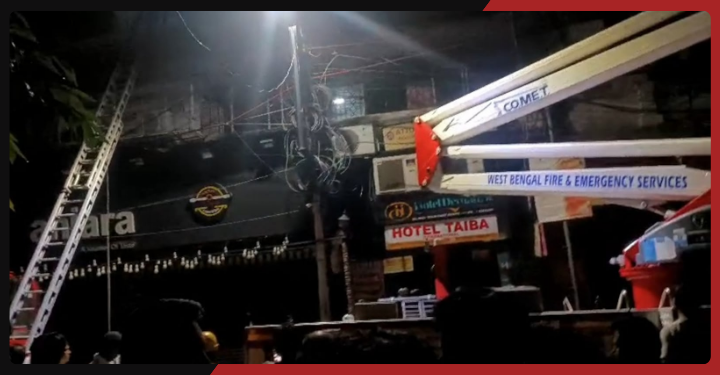
The deadly fire at a Kolkata hotel that claimed nine lives, including a child, has once again brought the city’s building and fire-safety arrangements under scrutiny.
The blaze erupted in the early hours of Wednesday at a hotel on Mirza Ghalib Street in central Kolkata. Fire officials received information about the incident at around 2 a.m., after which emergency teams rushed to the location.
The fire spread rapidly, filling parts of the building with smoke. Firefighters launched a search and rescue operation to locate people who were unable to escape. Several occupants were rescued and taken to hospital, but at least nine people died.
The victims reportedly included a child and several Bangladeshi nationals. Reports said the Bangladeshi visitors had come to Kolkata for medical treatment.
While the exact cause remains under investigation, preliminary reports have suggested an air-conditioner explosion. Authorities are expected to examine the hotel’s electrical systems and equipment before determining what triggered the fire.
The location itself is important to understanding the challenges faced by emergency responders. Central Kolkata contains many old and closely packed structures. Hotels, guest houses, shops and restaurants often operate within busy commercial neighbourhoods.
Such buildings can become especially dangerous during a fire if exits are narrow, emergency routes are blocked or smoke spreads quickly. Guests may also be unfamiliar with the building’s layout, making evacuation more difficult.
The latest tragedy has therefore raised questions about how regularly hotels are inspected and whether fire-safety rules are consistently enforced.
Fire safety involves multiple layers of protection. Buildings need reliable alarms to alert occupants quickly. Fire extinguishers and other firefighting equipment must be maintained. Emergency exits must remain accessible. Electrical systems and air-conditioning equipment require regular inspection. Hotel employees should also know how to respond when a fire occurs.
A failure in even one part of this system can increase risk. When several shortcomings occur together, the consequences can become catastrophic.
Kolkata has faced similar concerns before. The 2025 Rituraj Hotel fire in Burrabazar killed 14 people and exposed alleged problems involving emergency exits, ventilation, firefighting systems and combustible materials. The tragedy prompted authorities to take additional action concerning rooftop restaurants and safety compliance.
The latest incident will likely intensify demands for stricter inspections. Authorities may examine hotels operating in older buildings, particularly those in densely populated areas.
For hotel guests, fire safety is rarely the first concern when booking accommodation. People generally assume that a building has been approved and that emergency systems will work if needed. That assumption places a serious responsibility on hotel owners and regulators.
The death of a child in the latest fire makes the consequences particularly painful. Families who travelled to Kolkata for treatment or other purposes would not have expected a routine stay to end in tragedy.
The authorities now have to establish what happened, whether safety rules were followed and whether any negligence contributed to the deaths.
The investigation’s findings could become an important reference point for future safety measures across Kolkata.
The central lesson is clear: fire prevention must begin long before an emergency call is made. Regular inspections, proper maintenance and strict enforcement can reduce the risk of another tragedy.
The Mirza Ghalib Street fire has already claimed lives. The challenge for authorities now is to ensure that the lessons from the disaster lead to meaningful improvements rather than temporary attention that fades once the headlines disappear.



More Stories
Historic Tennessee Execution Turns Into Medical Emergency After Drug Failure
Israel-Bound Flydubai Flight Triggers Security Alert After Violent Cockpit Incident
Essar’s US Steel Ambition: Iowa Plant Expected to Produce 10 Million Tons by 2030