
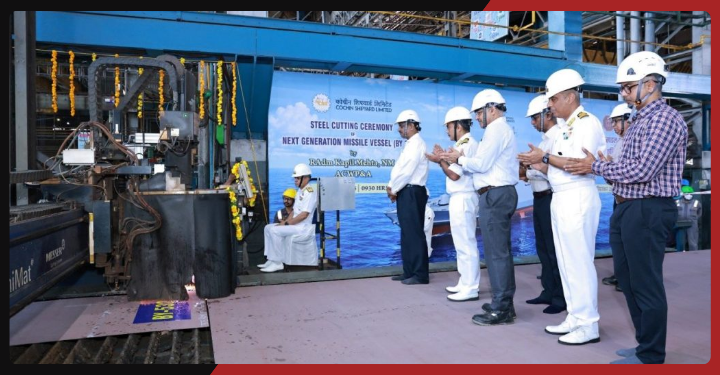
The Indian Navy’s Next Generation Missile Vessel programme has moved forward with the keel laying of its first ship at Cochin Shipyard Limited in Kochi. The six-vessel programme is designed around high-speed platforms carrying advanced missile and sensor systems for a range of maritime missions.
The first vessel’s keel was laid on September 18, 2026, during a ceremony attended by senior Navy and CSL officials. Vice Admiral Sanjay Sadhu, Controller of Warship Production and Acquisition, was the chief guest.
The NGMVs are expected to have a primary role in offensive maritime operations. Reporting on the programme says the vessels are intended to provide offensive capability against enemy warships and land targets, while also supporting maritime strike and anti-surface warfare operations.
Their design is centred on a combination of speed, weapons and sensors. The Times of India reported that the vessels are designed to achieve speeds of up to 33 knots and carry a crew of approximately 80 personnel.
Speed can be particularly important for smaller combat vessels operating in maritime environments where rapid movement and repositioning may be required. A fast ship can potentially reach an area of operation quickly and alter its position during a mission.
The NGMVs will also have advanced weapons and defensive systems. Official information released by the Ministry of Defence identifies surface-to-surface missile systems, anti-missile defence systems, air-surveillance radars and fire-control radars among the planned systems.
These capabilities serve different functions. Surface-to-surface missiles provide offensive strike capability, while anti-missile systems are intended to protect the vessel against incoming threats. Air-surveillance radars help monitor the surrounding airspace, and fire-control radars support weapon engagement functions.
The ships are not designed solely for offensive missions. Their planned duties also include local naval defence and protection of offshore development areas. This gives the platforms a broader role in maritime security.
The ability to operate around offshore infrastructure is relevant to India’s maritime interests because offshore areas can contain important economic assets. Protecting such areas can form part of wider naval and coastal defence responsibilities.
The vessels are also expected to have capabilities for sea-denial operations. The New Indian Express reported that the NGMVs are intended to act as an instrument of sea denial against enemy ships, particularly around maritime choke points.
The concept of sea denial involves making it difficult for an opposing naval force to operate freely in a particular maritime area. Fast missile vessels can contribute to such missions by combining mobility, surveillance and long-range weapons.
However, the NGMVs will operate as part of a larger naval force rather than independently. Their effectiveness will depend on coordination with other naval platforms, surveillance networks, aircraft, coastal systems and command-and-control infrastructure.
The programme’s six-vessel structure is also significant. The Indian Navy has contracted CSL to build six NGMVs under an agreement concluded in March 2023. The project has an order value of approximately ₹9,804 crore, according to CSL.
Construction began with the first steel-cutting ceremony in December 2024. The first ship has now reached keel laying, while steel cutting for the second ship took place on September 17, 2026.
The programme also reflects India’s domestic defence production ambitions. The Ministry of Defence says major role-defining equipment for the NGMVs is being developed and manufactured in India.
For CSL, the programme represents an expansion into advanced weapon-intensive naval platforms. It therefore has implications beyond the six vessels themselves, potentially adding to the shipyard’s experience with complex combatant construction.
The NGMVs are still under construction, meaning their final operational performance will ultimately depend on the completion of shipbuilding, system integration and trials. Nevertheless, the keel-laying milestone confirms that the first vessel has moved deeper into its construction cycle.
The project now enters another stage of development as the shipyard continues building the first vessel and begins work on additional ships in the six-vessel programme.



More Stories
Four Held In Delhi Teen’s Alleged Gang-Rape And Murder Case
Disha Salian Death Probe and Rs 500 Crore Legal Notice Put Aaditya Thackeray in Focus
Jensen Huang’s Trump Call Highlights Nvidia’s Growing Political Influence