
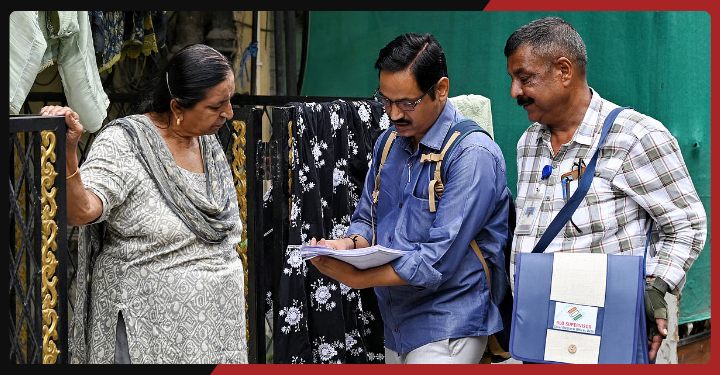
Nearly 11 lakh names were removed from Delhi’s electoral rolls before the Special Intensive Revision process began, according to recent reports, raising serious questions about voter awareness and administrative transparency.
The deletions reportedly occurred between January 2025 and June 2026—a period between the electoral preparations for the Delhi Assembly election and the start of the SIR exercise.
For election administrators, voter-list revision is a routine necessity.
Electoral rolls must reflect reality. Names of deceased voters need to be removed. Citizens who permanently move to another constituency should not remain incorrectly registered. Duplicate entries also need to be identified.
But the Delhi case has highlighted another equally important issue: what happens when an eligible citizen is removed without knowing?
Recent reporting indicates that several voters only discovered their deletion when the SIR process began. Some reportedly found that other family members received Enumeration Forms while they themselves did not.
That discovery created confusion.
A person who had voted previously could reasonably assume that their registration remained active. Without regular checking, there may be no reason to visit an electoral-roll website.
This is why the issue of notification has become central to the debate.
Should a voter receive direct information before or immediately after deletion?
Should authorities explain the reason?
Should there be an automatic mechanism for a citizen to challenge a potentially incorrect deletion?
These questions are not limited to Delhi. They are relevant to electoral administration across India.
The Election Commission has emphasised that the purpose of Special Intensive Revision is to maintain accurate and updated electoral rolls while protecting eligible voters through verification and claims-and-objections procedures.
But the pre-SIR deletions demonstrate how changes outside the intensive exercise can still influence participation.
If a voter was already missing from the roll when SIR began, the person could face difficulty entering the process through normal enumeration.
This effectively made awareness the first challenge.
A voter first had to discover that the name was missing before taking any steps to correct it.
The larger Delhi SIR exercise has intensified the debate because of its enormous scale.
The draft electoral roll showed around 97.53 lakh voters compared with approximately 1.45 crore electors before the revision. More than 47 lakh names were not included in the draft, with authorities categorising many as absent, permanently shifted, deceased or duplicate entries.
The nearly 11 lakh deletions before SIR therefore form an important part of the larger electoral story.
They suggest that Delhi’s voter list was already undergoing substantial changes before the intensive revision formally began.
For citizens, the situation offers a practical lesson.
Having an EPIC card does not necessarily mean a person should never verify their name again. Electoral status can change, and checking official records periodically can help prevent unpleasant surprises.
For authorities, the lesson may be even more significant.
Public trust depends not only on accurate results but also on transparent processes.
If citizens understand why names are removed and receive timely information, they are more likely to accept legitimate corrections.
But if voters discover months later that their names have vanished, suspicion and confusion are almost inevitable.
The story of Delhi’s nearly 11 lakh deleted voters is therefore ultimately a story about communication, transparency and democratic participation.


More Stories
Modi’s SCO Speech Sends Clear Signal: World Must Unite Against Terror
Kanpur Plane Crash: Timeline, Aircraft Details and What Investigators Will Examine
Indian Nationals Among Hundreds Missing in Nepal Floods; Embassy Activates Emergency Response