
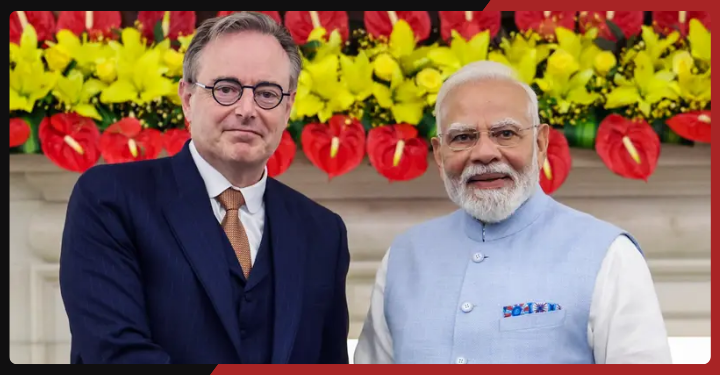
Belgian Prime Minister Bart De Wever’s remarks about Prime Minister Narendra Modi may signal an important new chapter in the relationship between India and Europe.
De Wever admitted that Europe had been warned about the risks of excessive economic dependence but had failed to respond quickly enough. He said India had understood the dangers earlier and that Prime Minister Modi’s warning was not properly heard.
Now, Europe is paying attention.
The timing of this statement is important.
The global order is undergoing major changes. Economic competition is increasing, geopolitical tensions are affecting trade and countries are becoming more concerned about protecting critical industries.
Europe is responding by looking for stronger partnerships.
India is becoming one of its most important options.
The relationship between India and European nations has traditionally focused heavily on trade and investment. Those areas remain important, but the partnership is now expanding into new strategic sectors.
Defence is becoming increasingly significant.
Technology cooperation is growing.
Clean energy has become a major priority.
Critical minerals and semiconductor supply chains are receiving greater attention.
This transformation reflects a new understanding of economic security.
In the modern world, control over supply chains can influence national security.
A disruption in the supply of energy, technology or industrial materials can have major consequences.
Countries therefore want partners they can depend upon during difficult times.
De Wever’s remarks suggest that Europe sees India as such a partner.
India is a large democracy with an expanding economy and growing influence on international affairs. It has also demonstrated an ability to maintain relationships with multiple global powers.
That makes India particularly important in a world increasingly divided by geopolitical competition.
The Belgian Prime Minister’s comments also highlight the growing confidence of India on the international stage.
India is no longer viewed simply as a developing economy with future potential.
It is increasingly viewed as a country that can influence global discussions on trade, technology and security.
Prime Minister Modi’s earlier warning about economic dependence is now being recognised by a European leader as an issue Europe should have taken more seriously.
That recognition could strengthen India’s diplomatic position.
At the same time, India and Europe have an opportunity to develop a partnership based on shared interests.
Neither side wants supply chains to become vulnerable.
Both want economic growth.
Both have an interest in stable international trade.
And both are increasingly concerned about the weaponisation of economic dependence.
These shared concerns could bring them closer together.
The India-Belgium agreements and discussions demonstrate how quickly the relationship is expanding.
Greater cooperation in investment, defence and strategic industries could create long-term benefits for both countries.
The broader India-Europe relationship could also become a major force in the global economy.
De Wever’s words about Europe being “a bit late” are therefore more than an admission of past mistakes.
They represent a recognition that the future requires a different approach.
Europe wants to become more resilient.
India wants to expand its global partnerships.
Together, they may be able to build a stronger economic and strategic relationship.
The warning may have come years earlier.
Europe may have listened late.
But the response could shape the next generation of India-Europe relations.

More Stories
Civilians Caught in the Crossfire as U.S.-Iran Hostilities Return
Kanpur Plane Crash: Timeline, Aircraft Details and What Investigators Will Examine
Indian Nationals Among Hundreds Missing in Nepal Floods; Embassy Activates Emergency Response