
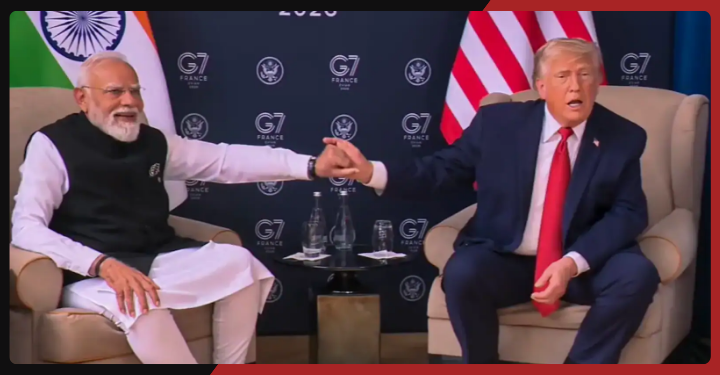
India’s electoral system has received an unexpected endorsement from US President Donald Trump, who is using the country’s voter-identification requirements to strengthen his argument for stricter election rules in America.
Trump has repeatedly called for stronger voter-ID requirements, but his latest comments are notable because he directly compared the United States with India.
The US president said India’s Chief Election Commissioner Gyanesh Kumar had questioned how American elections could be conducted without mandatory photo identification. Trump cited the reported conversation while demanding that Congress pass the SAVE America Act.
The proposed legislation would require Americans registering to vote in federal elections to provide documentary proof of citizenship. It would also establish stricter voter-identification requirements.
Trump argues that these measures are necessary to protect election integrity.
His administration’s official position is that citizenship verification and voter identification should be fundamental safeguards. The White House has explicitly pointed to India and Brazil as examples of countries where voter identification is linked to broader identity systems.
Trump’s comparison is based largely on the size of India’s electorate.
He said approximately 646 million people participated in India’s latest general election. He also emphasised that fewer than one per cent of voters used postal ballots, according to the figures he cited.
For Trump, these numbers support the argument that strict identification procedures can be implemented even when hundreds of millions of people participate in an election.
The Indian electoral system has indeed developed extensive mechanisms for identifying voters.
The Elector Photo Identity Card, commonly known as the voter ID or EPIC, is issued through the Election Commission’s electoral system. Voters must also be registered on the electoral roll and satisfy eligibility requirements.
However, identification is only one component of India’s election process. Electoral rolls, polling officials, electronic voting machines, voter-verifiable paper audit trails and other procedures form part of the broader framework.
The United States operates differently.
American elections are administered through states and local jurisdictions. Consequently, the rules governing identification, registration and voting differ depending on where a person lives.
Trump believes this decentralisation has created inconsistencies and vulnerabilities.
His supporters argue that the federal government should establish stronger minimum standards for federal elections. They say a voter should not face substantially different identity requirements simply because they live in another state.
Democrats and voting-rights groups have generally been concerned about the potential consequences of stricter documentation rules. Their argument is that election security must be balanced against ensuring that eligible citizens can vote without unnecessary obstacles.
This is why the SAVE America Act has become so politically divisive.
The law is not simply about identification cards. It touches on citizenship, registration, voting access and the balance between federal and state authority.
Trump’s invocation of India therefore serves both a policy and political purpose.
Policy-wise, he presents India as evidence that voter identification can work at enormous scale.
Politically, the comparison allows him to argue that his proposal is not unusual internationally.
The comments have also generated reactions in India. Opposition figures have questioned the Election Commission’s role and criticised the political implications of Trump’s remarks. Congress spokesperson Pawan Khera, for example, responded sarcastically to the development by suggesting that Gyanesh Kumar should be taken to America.
That reaction highlights the fact that the debate over election integrity is politically sensitive in India as well.
For now, Trump’s praise has placed India’s election system in the spotlight. The comparison is likely to continue as Congress debates the SAVE America Act and American voters prepare for the 2026 midterm elections.


More Stories
Rahul Gandhi’s Detention Deepens Political Clash Over India’s Electoral Process
Harmanpreet Kaur to Continue as Player After Giving Up India Captaincy Across Formats
Bolsonaro Fails to Pull Away as Brazil Election Heads Toward Second Round