
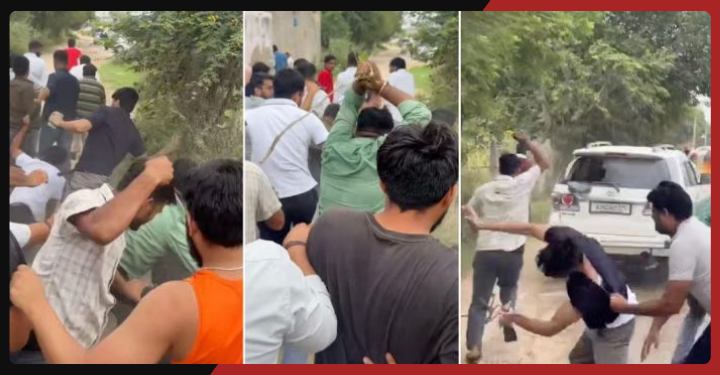
A confrontation involving members of the Cockroach Janta Party during a government-school visit in Rajasthan has put the state’s education infrastructure back at the centre of political debate. The CJP says its volunteers were attacked while attempting to inspect a school in Jaipur district, while local residents have disputed the organisation’s allegations and questioned its political role.
The incident occurred as CJP continues its “School Thik Karo” campaign. The initiative is designed to encourage citizens to inspect government schools and document infrastructure deficiencies. According to the organisation, volunteers have identified problems ranging from damaged buildings and unsafe roofs to inadequate toilets, drinking water, electricity and teacher availability.
Rajasthan has emerged as an important part of the campaign. CJP representatives have announced visits to multiple districts after receiving complaints from residents. The organisation says it intends to visit schools where local communities believe authorities have failed to address infrastructure problems.
During Friday’s visit to the Rampura-Kanwarpura area, the campaign encountered strong opposition. CJP co-convenor Ashutosh Ranka and other members were reportedly confronted by villagers. Video footage showed people chasing the CJP team away, while reports also mentioned damage to vehicles. CJP founder Abhijeet Dipke subsequently alleged that volunteers were beaten and accused BJP-linked individuals of involvement.
Those allegations have not been independently established. Local residents have offered a different account, saying they opposed the CJP’s political intervention. Some residents reportedly argued that government funds had already been sanctioned for school development and that local people were capable of dealing with the issue.
The controversy is particularly important because the Rajasthan government has recently tightened regulations governing access to government schools. A Directorate of Secondary Education circular said outsiders cannot enter school premises without prior permission from the principal or head of the institution. Photography, videography, interviews and live streaming involving students and school activities were also restricted without authorisation.
The department said the restrictions were introduced to protect the privacy, dignity and safety of children. The circular referred to constitutional privacy rights and national school-safety guidance. From the government’s perspective, schools cannot become unrestricted filming locations where children may be recorded or personal information circulated without safeguards.
But the restrictions have generated a separate political argument. CJP announced its inspection plans shortly before the order was issued. Critics have therefore questioned whether the restrictions could reduce public scrutiny of government schools. CJP has said it will continue its campaign despite the new rules.
The dispute highlights a genuine policy challenge. Governments need to protect children from unauthorised filming and interference, but communities also need mechanisms to report poor infrastructure. If school buildings are unsafe or basic facilities are missing, parents should have clear channels through which complaints can be made and independently verified.
One possible solution is greater transparency in official school inspections. Education departments could publish school-wise information about buildings, toilets, electricity, drinking water, teacher vacancies, repair work and sanctioned funds. Such information would allow citizens to verify whether government claims match conditions on the ground.
The political confrontation could also encourage authorities to improve communication with local communities. If residents know what funds have been allocated, when construction will begin and who is responsible for the work, disputes over school conditions may be less likely to become confrontational.
CJP’s campaign has succeeded in bringing attention to an issue that affects millions of children: the quality of public education infrastructure. But allegations of political involvement and violence can overshadow the educational problems the campaign seeks to highlight.
That is why the latest incident requires careful investigation. Claims of assault, vandalism and political mobilisation should be examined separately from the question of school infrastructure.
If wrongdoing occurred, those responsible should face lawful action. If government funding has already been sanctioned, authorities should explain the implementation schedule. And if the school genuinely lacks basic facilities, the priority should be completing the necessary work.
The Rajasthan controversy therefore goes beyond one school visit. It raises questions about how citizens, political organisations and governments should interact around public institutions.
For students, the desired outcome is simple: safe buildings, functioning classrooms, clean toilets, reliable water, electricity and teachers who can provide quality education.
Whether the CJP campaign can help achieve those goals without further confrontation will now be closely watched across Rajasthan.

More Stories
Historic Tennessee Execution Turns Into Medical Emergency After Drug Failure
Israel-Bound Flydubai Flight Triggers Security Alert After Violent Cockpit Incident
Essar’s US Steel Ambition: Iowa Plant Expected to Produce 10 Million Tons by 2030