
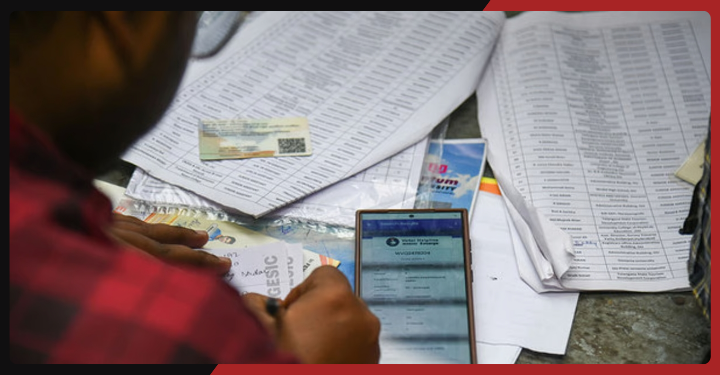
Family-Size Verification Criteria Draw Attention in Delhi’s SIR Exercise
NEW DELHI: Five verification criteria associated with family size and age relationships have emerged as a particular area of concern in Delhi’s Special Intensive Revision of electoral rolls after a data analysis found that Muslim voters accounted for a disproportionately high share of records flagged under these categories.
The analysis, reported on October 14, found that Muslims made up approximately 30% of the 6.75 lakh electors flagged under five family-size-related criteria. This compared with their estimated 13.6% share of all electors on Delhi’s draft electoral rolls.
The disparity has raised questions about how household information is evaluated during electoral verification and whether the rules used to identify unusual records produce consistent outcomes across different communities.
Family information can be useful when verifying electoral records. It may help officials identify duplicate entries, clarify relationships between household members or resolve inconsistencies in historical databases. However, such information must be interpreted carefully because real households do not always follow standard demographic patterns.
Differences in the recorded ages of parents, children and grandparents, for example, may require clarification without necessarily indicating that a voter is ineligible. Entries may also contain spelling differences, incomplete information or mistakes carried forward from earlier records.
The reported findings do not establish the specific reason for the disparity. They also do not prove that every voter flagged under these criteria was incorrectly identified. Determining whether the rules are functioning fairly would require a closer examination of the individual categories, the information used by the software and the outcomes of the subsequent verification process.
The distinction between identifying a discrepancy and determining eligibility is crucial. A software system can highlight a record that differs from an expected pattern, but the difference itself does not necessarily establish wrongdoing or ineligibility. Further examination may be required to understand the circumstances behind the entry.
For voters, the practical concern is how easily they can resolve a notice. If the problem involves a family relationship or an inconsistency in historical information, the instructions should clearly explain what needs to be clarified and which forms of evidence are acceptable.
Authorities should also recognise that not every household has the same access to old documents. Some voters may need assistance understanding official requirements or correcting information across different records. Accessible guidance and reasonable opportunities to respond can help ensure that administrative procedures do not become unnecessary obstacles.
The Election Commission of India could address the concerns by publishing detailed explanations of the five family-size-related criteria. It could clarify the purpose of each rule, explain the circumstances that trigger additional scrutiny and describe how officials distinguish genuine discrepancies from harmless variations.
An independent assessment could then test whether the criteria are producing comparable results across demographic groups. Researchers would need to examine not only the number of flags but also the proportion of cases that are confirmed as genuine errors, corrected through routine procedures or resolved without any change in voter eligibility.
This distinction matters because a high number of flagged records can have different explanations. It might reflect problems in the underlying data, criteria that are too broad or genuine differences in the records being examined. Aggregate figures alone cannot determine which explanation is correct.
The assessment should also consider whether some criteria place an unnecessary burden on particular groups. If the rules systematically flag harmless differences, the appropriate response may be to improve the software, revise the criteria or strengthen human review.
A transparent process would help voters, researchers and election administrators understand how the system operates. It would also give authorities an opportunity to correct weaknesses before they affect the final electoral roll.
The broader challenge is to use technology without allowing standardised assumptions to override individual circumstances. Automated checks can make large administrative exercises more manageable, but they should be supported by clear explanations and fair procedures.
Delhi’s reported figures make the family-size criteria an important subject for further investigation. A careful review could establish whether the observed disparity reflects a technical problem, an administrative issue or other factors requiring attention.
Ensuring accurate electoral rolls is essential, but accuracy must be achieved through procedures that are understandable, proportionate and fair. The findings provide an opportunity to examine whether Delhi’s verification rules meet that standard and whether improvements are needed to protect every eligible voter.


More Stories
Tragedy in Hyderabad as Young Software Engineer Dies in High-Rise Fall
Rescue Teams Race Against Time After Flash Flood Destroys Nepal Settlements
Rahul Gandhi’s Detention Deepens Political Clash Over India’s Electoral Process