
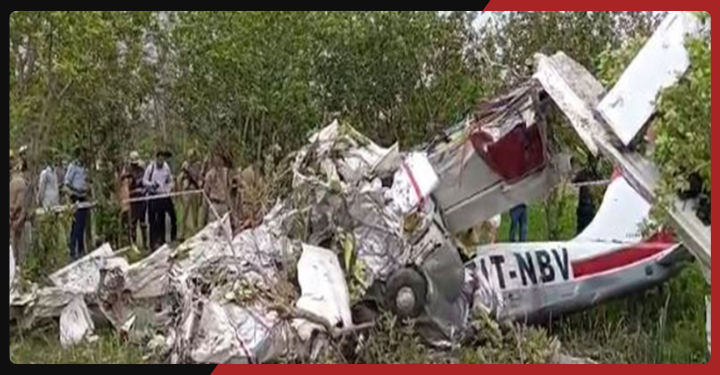
A training aircraft crashed near Kanpur’s Ganga Barrage on Thursday, killing both pilots on board and triggering an immediate emergency response. The accident involved a twin-engine Tecnam P2006T operated by Garg Aviation, with registration VT-NBV.
The aircraft was carrying an instructor and a trainee pilot when it crashed into an open field. According to the latest reports, neither pilot survived.
The crash site was near the Ganga Barrage area and Nathupurwa village. After the aircraft went down, local residents gathered near the location, while police and emergency personnel moved in to secure the area.
The aircraft was heavily damaged. Wreckage was visible across the field, making it clear that the impact had been severe.
Police teams cordoned off the crash site and began procedures to recover the bodies and preserve evidence. Administrative officials also reached the location as authorities started gathering information about the accident.
The next stage is the investigation.
The DGCA will have to establish a timeline of the flight and determine the circumstances that led to the crash. Investigators will look at the aircraft’s condition before the accident and the actions of the pilots during the final phase of the flight.
One of the first questions will be whether the aircraft experienced any technical difficulty. Investigators will inspect the engines, propellers, flight-control surfaces, landing gear and other components.
Maintenance documents will also be important. Investigators can determine whether the aircraft had undergone scheduled inspections and whether any technical issues had been reported previously.
The aircraft’s operational history may receive attention because VT-NBV was reportedly involved in a separate incident in June at Kanpur’s Chakeri Airport. A trainee pilot was injured after reportedly coming into contact with a running propeller while leaving the aircraft following a training session. DGCA ordered an investigation into that incident.
It is important, however, not to assume that the June incident caused or contributed to the August crash. Such a conclusion would require technical evidence.
Investigators will also examine the training plan. Training flights may involve specific exercises, and understanding what the pilots were attempting to do before the crash could help explain the sequence of events.
The aircraft’s flight path may provide another important clue. If reliable flight data are available, investigators can examine whether the aircraft suddenly changed altitude, speed or direction.
Communication records could also help determine whether the pilots reported an emergency. A distress call or communication with ground personnel could provide information about what happened before the aircraft hit the ground.
Weather will also form part of the standard investigation. Visibility, wind and other atmospheric conditions can affect aircraft operations, particularly during training flights. However, authorities have not identified weather as a cause.
The investigation will also examine human factors. This could include pilot workload, training conditions, procedures and any possible operational issues. Again, this does not mean that pilot error has been established.
The early reports surrounding the accident changed as authorities confirmed information. Initial reports indicated that one pilot had died and the other was critically injured, while later reports confirmed the deaths of both pilots.
Such changes are common in the first hours after an aviation accident because emergency personnel are still working at the scene and information is being verified.
For now, the confirmed facts are that a Garg Aviation training aircraft crashed near the Ganga Barrage, two pilots died and the DGCA is investigating.
The final investigation will take time. Aviation accident reports are designed not merely to assign blame but to establish causes and identify measures that could improve safety.
The Kanpur crash therefore carries significance beyond the immediate tragedy. Its findings could provide important information for flight-training organisations, instructors, regulators and trainee pilots.
The aviation community will now await the results of the investigation. Until those findings are available, any explanation for the crash should be regarded as unconfirmed.
What is beyond doubt is the human cost: two pilots lost their lives during a training flight, leaving families and colleagues facing a devastating loss.


More Stories
Indian Nationals Among Hundreds Missing in Nepal Floods; Embassy Activates Emergency Response
New H-1B Proposal Faces Legal Battle After Earlier $100,000 Fee Was Struck Down
Space Technology Beyond Rockets: PM Modi Wants Startups to Transform Agriculture and Environment