
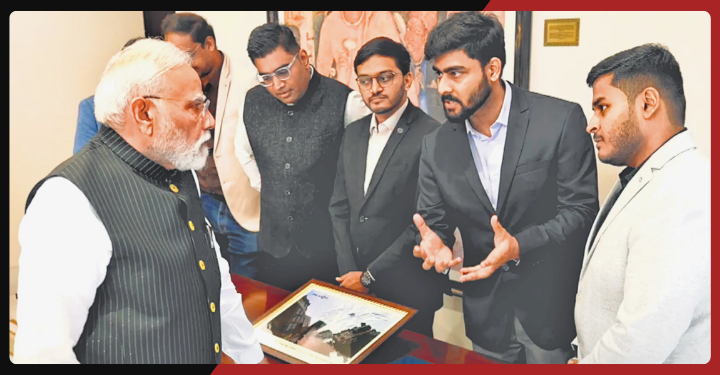
Prime Minister Narendra Modi has called for India’s growing space startup ecosystem to look beyond rockets and satellites and focus on applications that can directly improve people’s lives. During an interaction with CEOs and founders of 20 space startups, he encouraged companies to expand the use of space technology in areas such as agriculture, livestock, dairy and environmental monitoring.
The message reflects a broader understanding of what India’s space economy could become. Space technology is increasingly relevant to sectors far beyond traditional exploration.
Satellite imagery, navigation systems, weather information and remote sensing can support decision-making across multiple industries. For agriculture, space-based information can help monitor crops, assess weather patterns and identify environmental changes.
Modi encouraged companies working on agricultural applications to collaborate with agricultural universities and government departments. Such partnerships could help convert sophisticated satellite technology into practical tools for farmers.
Environmental applications are another area with significant potential. Modi suggested that startups working on space debris should collaborate with environmental organisations. This could help companies expand technologies designed to monitor and address debris while connecting them with broader environmental objectives.
The Prime Minister’s focus comes as India’s private space industry expands rapidly. Government data released in July showed that private investment in the sector had crossed $618 million and that 105 authorisations had been granted to private entities.
India’s startup ecosystem has also grown beyond 400 companies, according to government figures.
The companies participating in Modi’s interaction represented a wide variety of technologies, including launch vehicles, satellites, propulsion, avionics, intelligence systems, debris removal and AI-powered weather and climate intelligence.
This diversity provides a foundation for expanding space technology into other industries.
Modi has also argued that India can establish itself rapidly in the global space sector because of its cost competitiveness, talent and risk-taking capacity.
For startups, this creates two simultaneous opportunities. They can build products for the Indian market while also developing technologies that can be sold internationally.
The Prime Minister has urged the industry to create an ecosystem that attracts global talent, companies and investment. He wants the world to associate India with space innovation and see the country as a destination for building a career in the industry.
Policy stability is another important part of this strategy. Entrepreneurs investing in complex space technologies need confidence that regulations and government decisions will remain predictable.
Education will also play a role. Modi suggested closer collaboration with Atal Tinkering Labs to encourage children to develop curiosity about science and space.
The approach could create a larger pipeline of young engineers and innovators capable of supporting India’s expanding space economy.
The emphasis on real-world applications could also help the industry demonstrate its economic value. Space technology becomes more meaningful when it contributes to food production, weather forecasting, environmental protection and other everyday challenges.
India’s future in space, therefore, may not be defined only by missions beyond Earth. It could also be shaped by how effectively satellite and space technologies are integrated into life on Earth.
Modi’s message to startups is that India’s space ambitions should combine scientific achievement with commercial innovation and social impact.
If companies can successfully turn space-based technologies into practical solutions, India’s private space sector could become an important engine of both technological advancement and economic growth.



More Stories
Delhi Police’s New Rule for Gen Z Protests: Don’t Argue, Don’t React, Don’t Become Viral Content
What Led to the Fatal Attack on an Adobe Techie? Police Probe Matrimonial Dispute
Rajasthan School Row Puts Government Infrastructure Under Fresh Political Spotlight