
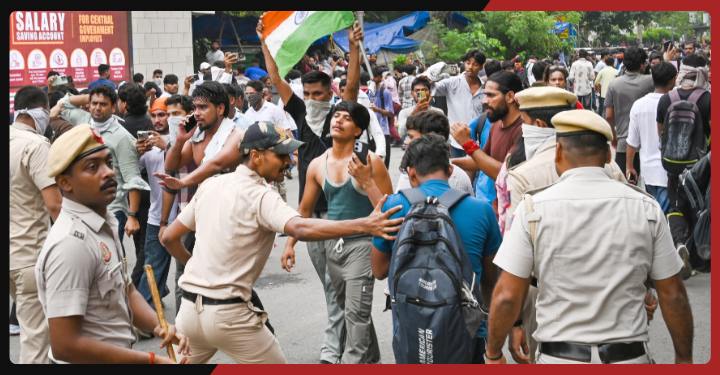
Delhi Police has reportedly issued a set of instructions aimed at helping its personnel handle Gen Z protesters more effectively, with a particular focus on avoiding unnecessary arguments and emotional reactions.
The advisory comes after the recent Jantar Mantar protests, where interactions between police and young demonstrators were frequently captured on smartphones. The resulting videos became part of the wider social-media conversation surrounding the demonstrations.
The reported instructions are built around one major principle: police personnel should assume that they are being filmed.
Officers have reportedly been told not to engage with protesters who attempt to provoke them. Instead, they should remain calm and avoid reacting to questions or emotional appeals that are not directly related to their duties.
If a response is necessary, personnel have reportedly been advised to say, “Please cooperate, we are doing our duty.” Otherwise, they should maintain silence.
The approach is designed to prevent routine verbal exchanges from becoming viral clips.
In today’s protest environment, a young demonstrator does not necessarily need a television crew or newspaper reporter to document an event. A smartphone can capture video, record sound and publish the material almost instantly.
This has transformed the relationship between protesters and law enforcement.
The advisory reportedly warns officers that protesters may use emotional behaviour to generate reactions. Crying, making personal appeals or asking questions about family and financial circumstances can create opportunities for sympathy or anger. Police personnel have been told not to get drawn into these conversations.
The focus is not necessarily on assuming bad intentions from every protester. Instead, the reported guidance appears to recognise that demonstrations now take place in an environment where people actively create content.
Recent youth-led protests in India have demonstrated how memes, reels and digital platforms can become central to protest communication.
The Jantar Mantar protests were an example of this changing style. Young protesters used cameras not only to document their own activities but also to record police behaviour.
The police advisory reportedly asks officers to remain conscious of this dynamic.
The guidelines also reportedly contain specific advice about women protesters. Personnel have been asked to avoid unnecessary physical contact and allow women police officers to handle such situations whenever possible.
Such instructions can help reduce the possibility of misunderstandings and unnecessary confrontations during crowded demonstrations.
However, the police still face the fundamental responsibility of maintaining law and order. If protesters attempt to break barricades, enter restricted areas or engage in violence, officers may have to take action.
The challenge is ensuring that necessary enforcement does not turn into unnecessary confrontation.
That distinction has become increasingly important because the public often sees protest incidents through short clips rather than complete recordings. A video showing an officer shouting may receive more attention than hours of peaceful crowd management that preceded it.
The reported advisory appears to recognise this reality.
By remaining silent, calm and professional, police officers can limit the possibility of their individual reactions becoming the story.
The guidelines therefore represent an attempt to modernise police conduct for a generation that understands social media instinctively. In a world of reels and viral clips, maintaining composure is no longer simply a matter of professional etiquette. It can also be an important part of managing public order.
Delhi Police’s message to personnel is ultimately straightforward: do the job, remain composed and do not provide unnecessary material for the camera.




More Stories
Dipke’s Warning Signals Wider Clash Over Election Commission’s Role
Flydubai Crisis: Injured Indian Captain Smit Machchhar Helps Passengers Regain Control
Historic Tennessee Execution Turns Into Medical Emergency After Drug Failure