
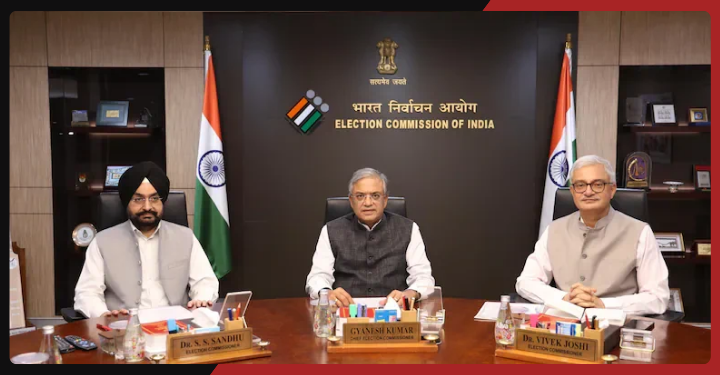
The controversy surrounding Gyanesh Kumar and the Election Commission cannot be understood separately from the Special Intensive Revision of electoral rolls.
SIR has become one of the most significant electoral-administration exercises in recent years. Its purpose is to review and update electoral rolls, but the process has also generated political and legal debate over voter verification and the treatment of electoral data.
Reports that Election Commissioners Sukhbir Singh Sandhu and Vivek Joshi recorded objections to several decisions during the process intensified that debate. The Indian Express reported at least 14 instances of formal objections over 10 months, covering issues including voter registration, deletion and restoration of names and changes involving Form 6.
The Election Commission has responded by stressing that internal deliberation should not be confused with final institutional decisions.
The poll body said that differing views, observations and technical suggestions are normal in a multi-member constitutional institution. It maintained that all final decisions were unanimously approved by the Commission.
The controversy matters because electoral rolls are fundamental to elections.
Before voters can participate, their names must appear on electoral rolls according to the applicable legal requirements. An accurate roll should include eligible voters while preventing duplication and other irregularities.
That creates a difficult administrative balance.
On one side is the need to identify incorrect, duplicate or otherwise problematic entries. On the other is the need to ensure that eligible voters are not wrongly excluded or subjected to unnecessarily complicated verification procedures.
The recent Supreme Court proceedings in Delhi demonstrate the sensitivity of the issue. The Court questioned the Election Commission about notices issued over “logical discrepancies” and sought an explanation for the rationale behind those notices. Another report said the Court suggested allowing voters to respond through modern communication channels such as WhatsApp and email.
The judicial scrutiny does not itself establish that the entire SIR process is unlawful. Instead, it shows that particular procedures are being examined and that the Election Commission has been asked to explain aspects of its implementation.
Technology is another important part of the debate.
The ECI has increasingly used digital systems for electoral-roll management and election administration. Reports have raised questions about the management and centralisation of electoral data. The Commission has responded that its digital platforms, including ECINet, are protected by strict security protocols and that its actions comply with applicable law.
The issue has therefore expanded beyond the personalities involved.
Gyanesh Kumar is the current CEC, but the debate concerns the functioning of the institution as a whole. Sandhu and Joshi are also members of the same constitutional body, and the Commission’s official position is that all three participate in collective decision-making.
The latest political development has further broadened the discussion. On September 26, leaders of three NDA allies called for greater clarification from the ECI, arguing that questions surrounding the electoral process should be addressed in the interest of public confidence.
The Commission now faces a communication challenge as much as an administrative one.
It has already stated that internal differences are normal and that final decisions were unanimous. But public discussion continues because the reported objections involved issues directly connected with electoral rolls.
For voters, the practical questions remain straightforward: how are names added or removed, how are discrepancies identified, what evidence can voters provide, how are objections considered, and what safeguards exist against errors?
Clear answers to those questions can help separate the technical operation of SIR from the wider political controversy surrounding the Election Commission.
The Gyanesh Kumar controversy therefore represents a broader debate about electoral administration, transparency and public confidence. Its resolution will depend on the Commission’s explanations, documentary records, judicial proceedings and the continued functioning of the electoral-roll system.

More Stories
Police Probe Viral Rape Claim After LPU Protest Turns Violent and Traffic Is Disrupted
Nine Dead After Private Sleeper Bus Fire Near Noida International Airport
Japan Issues Warnings Across Eastern Regions as Typhoon Dujuan Intensifies Weather Threat