
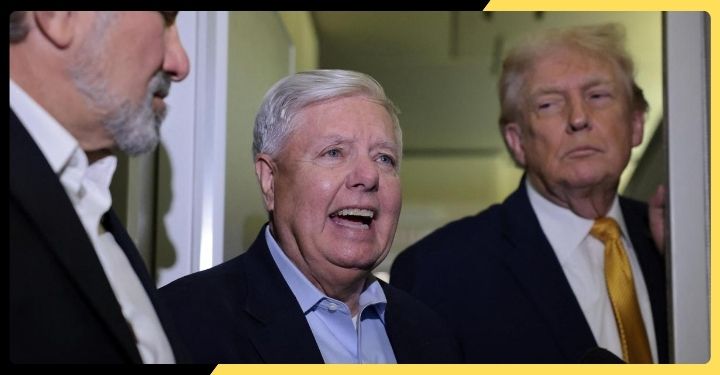
U.S. President Donald Trump has given his backing to a sweeping bipartisan sanctions bill aimed at intensifying economic pressure on Russia, a move that could have far-reaching consequences for major emerging economies such as India, China and Brazil. The proposed legislation, which targets countries continuing to trade extensively with Moscow—particularly in energy—signals a sharper and more confrontational phase in Washington’s approach to the Russia-Ukraine conflict.
The bill, promoted by senior lawmakers from both parties, seeks to curb Russia’s ability to finance its war effort by going beyond traditional sanctions on Russian entities. Instead, it focuses on so-called “secondary sanctions,” allowing the United States to penalize third-party countries that maintain significant commercial ties with Russia. At the heart of the proposal is the threat of imposing tariffs of up to 500 percent on imports from nations that continue to purchase Russian oil, gas, and other strategic commodities.
Trump’s decision to “greenlight” the bill marks a notable political moment. While he has often criticized sanctions as blunt instruments that can hurt U.S. businesses, he has also emphasized the use of aggressive trade measures as leverage in foreign policy. By backing this bill, Trump appears to be blending both approaches—using the power of U.S. markets and tariffs to force changes in international behavior, while retaining executive discretion over how and when the penalties are applied.
Why India, China and Brazil Are in Focus
India and China have emerged as the largest buyers of Russian crude oil since Western countries imposed sanctions on Moscow following its invasion of Ukraine. Discounted Russian oil has helped both economies manage inflation and sustain growth amid global uncertainty. Brazil, while a smaller buyer in comparison, has also increased imports of Russian energy and fertilizers, viewing them as essential for its domestic economy.
U.S. lawmakers backing the sanctions bill argue that these purchases indirectly bankroll Russia’s military operations. By threatening severe tariffs on exports from these countries to the United States, the bill aims to force a reassessment of their trade relationships with Moscow. Supporters say the strategy closes loopholes in the current sanctions regime and sends a clear message that neutrality in the conflict comes at a cost.
Potential Economic Fallout
If enacted, the bill could dramatically reshape global trade flows. A 500 percent tariff would effectively shut many exporters out of the U.S. market, disrupting supply chains and raising prices for consumers. Indian manufacturers, Chinese industrial exporters, and Brazilian agribusinesses could all face significant losses if their goods become uncompetitive in the U.S. due to punitive duties.
Energy markets could also feel the impact. Should India or China reduce their purchases of Russian oil to avoid sanctions, global demand could shift rapidly, potentially driving prices higher. Conversely, Russia may be forced to offer even deeper discounts or seek alternative buyers, further fragmenting global energy markets.
Economists warn that such aggressive measures carry risks for the United States as well. Retaliatory tariffs, reduced cooperation in multilateral forums, and legal challenges through international trade bodies could all follow. Critics of the bill argue that broad trade penalties may hurt allies and partners more than Russia itself, while also undermining the rules-based global trading system.
Diplomatic Reactions and Strategic Calculations
Early reactions from the targeted countries have been cautious but firm. Indian officials have consistently maintained that New Delhi’s energy policy is guided by national interest and affordability, not geopolitics. China, for its part, has repeatedly criticized unilateral sanctions and warned against what it sees as economic coercion by the United States. Brazil is likely to echo similar concerns, emphasizing its sovereign right to pursue trade relationships that support domestic development.
Behind the scenes, diplomats in all three countries are expected to intensify engagement with Washington, seeking exemptions, waivers, or a softening of the bill’s most severe provisions. The legislation reportedly includes mechanisms that allow the U.S. president to delay or waive sanctions in certain circumstances, a feature designed to preserve flexibility and avoid sudden economic shocks.
Domestic Politics in Washington
Within the United States, the bill reflects strong bipartisan frustration over the prolonged war in Ukraine and the perception that existing sanctions have not been sufficient to alter Russia’s behavior. Supporters argue that targeting Russia’s biggest customers is the logical next step, especially as Moscow has adapted to earlier restrictions.
Trump’s endorsement also carries domestic political implications. By backing a tough stance on Russia while emphasizing tariffs rather than military escalation, he reinforces his image as a leader who prioritizes economic tools over direct intervention. At the same time, he can point to the bill’s bipartisan nature as evidence of unity on a key foreign policy issue.
However, some lawmakers and business groups remain skeptical. They warn that escalating trade conflicts with major economies like India and China could undermine U.S. strategic interests, particularly in the Indo-Pacific, where Washington seeks closer cooperation to counterbalance China’s influence.
What Comes Next
The sanctions bill is expected to move through Congress in the coming weeks, with debate likely to focus on the scope of the tariffs and the degree of presidential discretion. Amendments may seek to narrow the list of targeted countries or provide clearer criteria for imposing penalties.
If passed, the legislation would place significant pressure on India, China, and Brazil to reconsider their economic engagement with Russia. Whether it succeeds in weakening Moscow’s war effort—or instead triggers a new wave of global trade tensions—will depend on how forcefully the measures are implemented and how affected countries respond.
What is clear is that Trump’s backing of the bill has raised the stakes. By linking the Ukraine conflict to global trade in such a direct way, the United States is signaling that the economic consequences of the war will increasingly be felt far beyond Europe, reshaping alliances and markets in the process.




More Stories
Explosions in Tehran After Israel Declares ‘Preventive Strike’ on Iran
Storm Over ‘Underwear Order’: Minister Demands Clarity from BSNL Leadership
Seven Feared Dead After Air Ambulance Disappears From Radar and Crashes in Jharkhand