
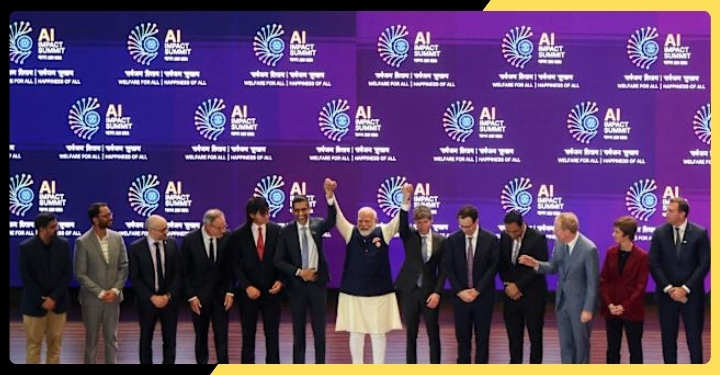
If you wanted a snapshot of India’s AI ambitions in 2026, you could find it in the crowded corridors of its latest AI summit: optimism colliding with operational reality.
The event promised clarity on how India could unlock a $200 billion AI economy. Instead, it revealed something more nuanced — a system still aligning its parts.
The hype was unavoidable. Exhibition halls showcased AI avatars, predictive analytics dashboards, autonomous systems, and generative tools. Startups pitched with urgency. Investors scanned for breakout ideas. The atmosphere felt electric.
But step into quieter conversations, and the narrative shifted.
Founders spoke candidly about the cost of training large models. Access to advanced semiconductors remains constrained. Many rely on partnerships with foreign cloud providers. Questions around data governance linger. “We’re building fast,” one CTO told me, “but the rails are still under construction.”
Government representatives stressed self-reliance and innovation. Yet attendees quietly debated whether India should invest heavily in foundational AI research or focus on domain-specific applications — healthcare, agriculture, financial inclusion — where impact might be faster and more tangible.
The summit’s most productive sessions weren’t the headline keynotes. They were technical roundtables on model optimization, open-source collaboration, and talent development. Here, the conversation turned practical: How do you reduce inference costs? How do you prevent model bias across diverse linguistic datasets? How do you retain AI researchers who receive offers from abroad?
Despite the friction, momentum is undeniable. India’s startup ecosystem is maturing. Enterprise adoption of AI is accelerating. Universities are expanding AI curricula. There is alignment, even if imperfect, around the importance of this moment.
The core lesson from the summit is this: ambition is necessary but insufficient. Declaring a $200 billion opportunity doesn’t automatically create it. Execution — in policy, infrastructure, capital allocation, and education — will determine whether projections become reality.
What I witnessed wasn’t failure. It was friction — the kind that accompanies transformation. Innovation at national scale is rarely orderly.
India’s AI story is still being written. The summit showed both the scale of the dream and the complexity of achieving it. If stakeholders can convert today’s confusion into coordinated action, the chaos may one day look like the sound of something powerful being built.




More Stories
Multi-State Raids Lead to Arrest of Eight in Alleged Lashkar Terror Module
Teenager Dies After Jumping in Front of Metro Train at Uttam Nagar East Station
EU Launches Legal Mobility Gateway Office in Delhi; Jaishankar Calls It ‘Mobility With Purpose’