
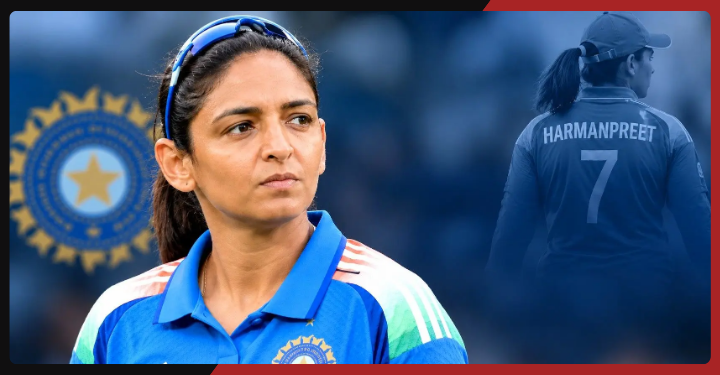
Harmanpreet Kaur’s decision to step down as captain of the Indian women’s cricket team does not mark the end of her international career. Instead, the veteran all-rounder will continue to represent India as a player after relinquishing the leadership role across all three formats.
The announcement came after a Board of Control for Cricket in India review meeting in Guwahati, bringing an end to Harmanpreet’s long tenure as one of the most prominent leaders in Indian women’s cricket. Her decision has created a major leadership vacancy, but it also allows the Indian team to retain the experience of a player who has spent years at the highest level.
Harmanpreet’s captaincy journey began in T20 internationals in 2016. She later became India’s full-time ODI and Test captain in 2022 following the retirement of Mithali Raj. Since then, she has been responsible for leading the national team through a wide range of international challenges.
Her time as captain included some of the most important achievements in Indian women’s cricket. The biggest highlight was India’s historic Women’s ODI World Cup victory under her leadership. The title represented a landmark moment for the country and gave the Indian women’s team its first ODI World Cup championship.
Harmanpreet also led India during successful campaigns at the Asian Games, where the team won gold medals in consecutive editions. Her leadership therefore became associated with a period in which Indian women’s cricket achieved greater recognition and success on the international stage.
Despite those achievements, captaincy came with enormous pressure. Leading India meant facing constant scrutiny over team selection, tactical decisions, player combinations and match results. Harmanpreet’s farewell message reflected the personal demands of the position, including sacrifices that were sometimes necessary for the benefit of the team.
Stepping down could now allow her to concentrate entirely on her role as a cricketer.
That change could be particularly important for Harmanpreet because playing and captaining simultaneously requires a considerable mental and physical commitment. A captain must constantly think about the wider team while also preparing to perform individually.
Without the captaincy, Harmanpreet can focus more closely on her own batting, bowling and fitness. She can also contribute to the team without having to carry the responsibility of making every major leadership decision.
Her experience, meanwhile, remains an important asset. Harmanpreet has played hundreds of international matches and has faced some of the most difficult situations in international cricket. Younger members of the squad can benefit from that experience, particularly during major tournaments and high-pressure matches.
Her continued presence could also help the new captain settle into the role. If Smriti Mandhana becomes the next captain, Harmanpreet’s knowledge of the squad and understanding of international leadership could prove useful.
The leadership transition will be watched closely because Harmanpreet has been one of the defining figures of Indian women’s cricket for so long. Her departure from the captaincy does not mean, however, that her influence will disappear from the dressing room.
In fact, the change could create a different dynamic within the team. A new captain will have greater freedom to establish a leadership style, while Harmanpreet can act as a senior player and experienced voice.
This arrangement is common in international sport. Former captains often remain important members of their teams after giving up leadership responsibilities. Their knowledge can help younger leaders avoid mistakes and understand the pressures associated with international competition.
For the BCCI, retaining Harmanpreet as a player is likely to be valuable as India enters a new phase. The board now has to identify a successor capable of leading the team while ensuring that the transition does not affect performance.
Smriti Mandhana is among the leading candidates for the role, given her position as vice-captain and her considerable international experience. However, the final decision will rest with the BCCI.
Whoever becomes captain will inherit a team that has achieved historic success but also faces high expectations. India’s World Cup triumph has raised the standard supporters expect from the national side, while the development of young players has added another important priority.
Harmanpreet can now contribute to both objectives from a different position.
Her career has already had a lasting impact on Indian women’s cricket. She was part of a generation that helped transform the sport’s popularity and professional status in India. Her aggressive batting, competitive approach and leadership made her a prominent figure well beyond the cricket field.
The decision to step down therefore should not be seen simply as a retirement from responsibility. It is a change in role.
After years of leading India, Harmanpreet can now return her attention to the fundamental task of performing on the field. She will still have an opportunity to contribute to victories, mentor younger players and share the experience gained during her captaincy.
For fans, the announcement may initially feel like the end of an era. But Harmanpreet’s decision means supporters will continue to see her in Indian colours.
The captaincy chapter is over, but the playing chapter continues.
That could ultimately prove beneficial for both Harmanpreet and India. The team gains an experienced international cricketer without the burden of leadership, while Harmanpreet gets an opportunity to concentrate on her own performances.
As Indian women’s cricket prepares for a new captain, one thing remains certain: Harmanpreet Kaur’s role may have changed, but her importance to the team has not necessarily diminished.


More Stories
Bolsonaro Fails to Pull Away as Brazil Election Heads Toward Second Round
Yemen Conflict Intensifies as Army Reports Hundreds of Strikes on Houthi Targets
Historic Tennessee Execution Turns Into Medical Emergency After Drug Failure